Shrimp shell
Penaeus spp.
Chitin17-32%
Ash34%
Protein40%
Highest-volume marine feedstock; thin cuticle, easy demineralisation.
Shell waste to chitin, chitin to chitosan or chito-oligosaccharides, and enzymatic depolymerisation to N-acetylglucosamine - the nitrogen platform behind sialic acid, 3A5AF furans and medical-grade biomaterials. Every model output states whether it is cited, interpolated or illustrative.
Drag the chain to rotate it. Alternating residues flip 180 degrees, which is what lets the acetamido groups hydrogen bond between chains and lock alpha chitin into its antiparallel sheets.
Schematic beta-(1->4) linked N-acetylglucosamine chain. Alternate residues are flipped 180 degrees, which is what lets the C=O and N-H groups form the interchain hydrogen bond sheets that make alpha chitin so recalcitrant.
From mineralised cuticle to purified nanofibrils to deacetylated plates. Zoom into any plate to inspect the surface the enzyme has to work on.
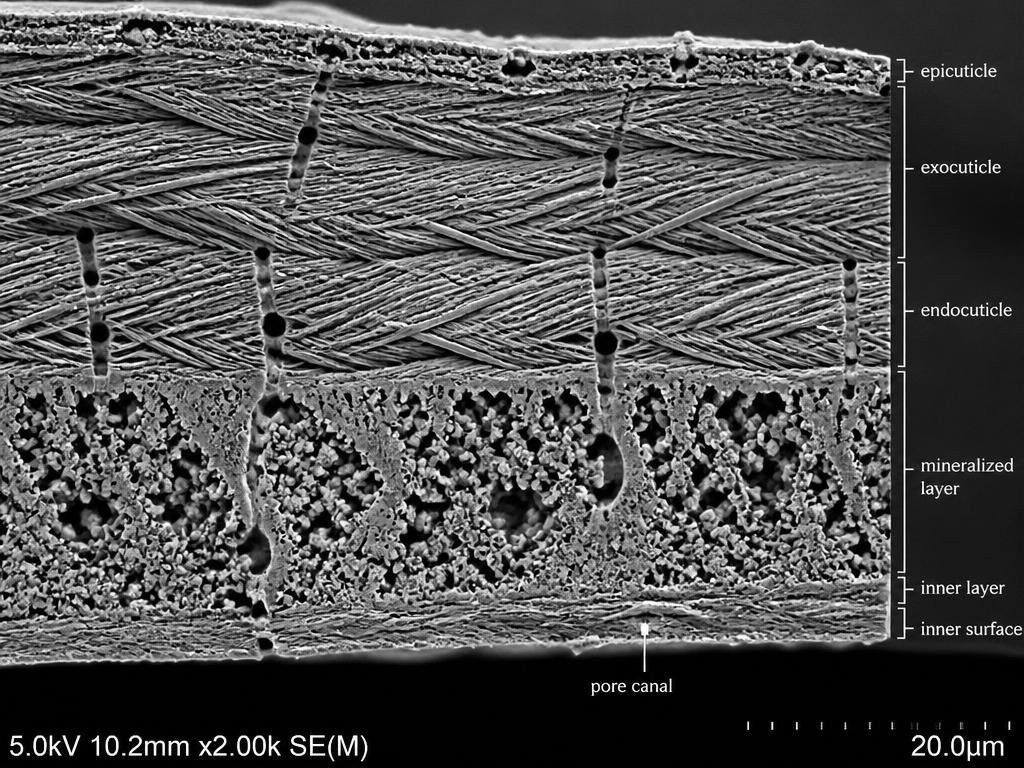
Bouligand twisted plywood of chitin protein fibres with the mineralised layer still intact. Pore canals run normal to the lamellae and set the diffusion path for demineralising acid.
Plates are representative renderings of published morphologies, not original data from a specific instrument run.
Composition drives the process. Mineral load sets the demineralisation stage; allomorph sets enzyme accessibility.
Penaeus spp.
Highest-volume marine feedstock; thin cuticle, easy demineralisation.
Portunus / Scylla
Heavily mineralised - CaCO₃ dominates, needs stronger acid stage.
Loligo spp.
β-allomorph: parallel chains, weak H-bonding, superior reactivity.
Aspergillus / Mucor
Chitin-glucan complex; vegan route, no demineralisation needed.
Hermetia illucens
Black soldier fly larvae - circular bioeconomy feedstock.
Euphausia superba
High lipid load requires a defatting stage before deproteinisation.
Illustrative flows anchored to literature recovery ranges. Hover any stream to read the transformation.
Hover a node to isolate its mass flow. Values normalised per 100 kg dry shell waste.
GH18 endo- and exo-chitinases release oligomers, GH20 hexosaminidases finish the job, and AA10 LPMOs oxidatively nick the crystalline regions the hydrolases cannot reach.
Random internal cleavage of β-1,4 bonds
Product: Chito-oligosaccharides (DP 2-6)
Processive release from non-reducing end
Product: Chitobiose (GlcNAc)₂
Terminal monomer release from oligomers
Product: N-acetylglucosamine
Hydrolyses deacetylated chitosan chains
Product: Chitosan oligomers (COS)
Removes acetyl groups, no chain scission
Product: Chitosan / glucosamine
Oxidative cleavage of crystalline regions
Product: Oxidised chain ends (boosts GH18)
Centre anchored to the published optimum for the Bacillus velezensis chitinase (pH 7.0, 44 °C, DOI 10.1007/s11356-022-22166-x). Surrounding surface is illustrative.
Six transformations from crystalline polymer to platform chemical, each naming the catalyst, the EC number and the stoichiometry.
Random internal cleavage of beta-(1->4) bonds by substrate-assisted catalysis. Rapidly drops degree of polymerisation and viscosity.
Change the extraction route and see purity, ash, degree of deacetylation, GlcNAc yield and greenness respond. The model is parameterised and transparent, not a process simulator.
Eight stages end to end - host selection and strain engineering, seed train, fermentation, harvest, capture, chromatography, polishing and formulation, then biocatalysis. Each stage exposes its Critical Process Parameters and reports Critical Quality Attributes against spec, with the yield cascade carried through the whole train.
Reference strain of the published study; GRAS, strong Sec secretion, no endotoxin.
Chitin agar clearance-zone screening; the baseline of the published work.
Bars 1-7 are cumulative activity recovery; the final bar is chitin-to-GlcNAc conversion in the biocatalysis reactor. Correlations are literature-shaped and transparent - a teaching model, not a validated process simulator.
The economics live here: a low-value waste stream carries nitrogen already installed in the ring, which is what makes the furan and sialic acid routes attractive.
from Chitin
Nutraceutical, osteoarthritis, cosmeceutical
Joint health, skin barrier, precursor to sialic acid
from Chitin / chitosan
Antimicrobial, plant elicitor, immunomodulator
Biocontrol sprays, functional food, drug delivery
from GlcNAc deacetylation
Global supplement supply chain
Cartilage support, veterinary feed
from GlcNAc dehydration
Platform chemicals, bio-polyesters
Nitrogen-containing furans, resins, solvents
from GlcNAc epimerisation
Infant formula, antivirals
Zanamivir precursor, HMO synthesis
from Deacetylated chitin
Haemostats, wound dressing, scaffolds
Tissue engineering, gene delivery, water treatment